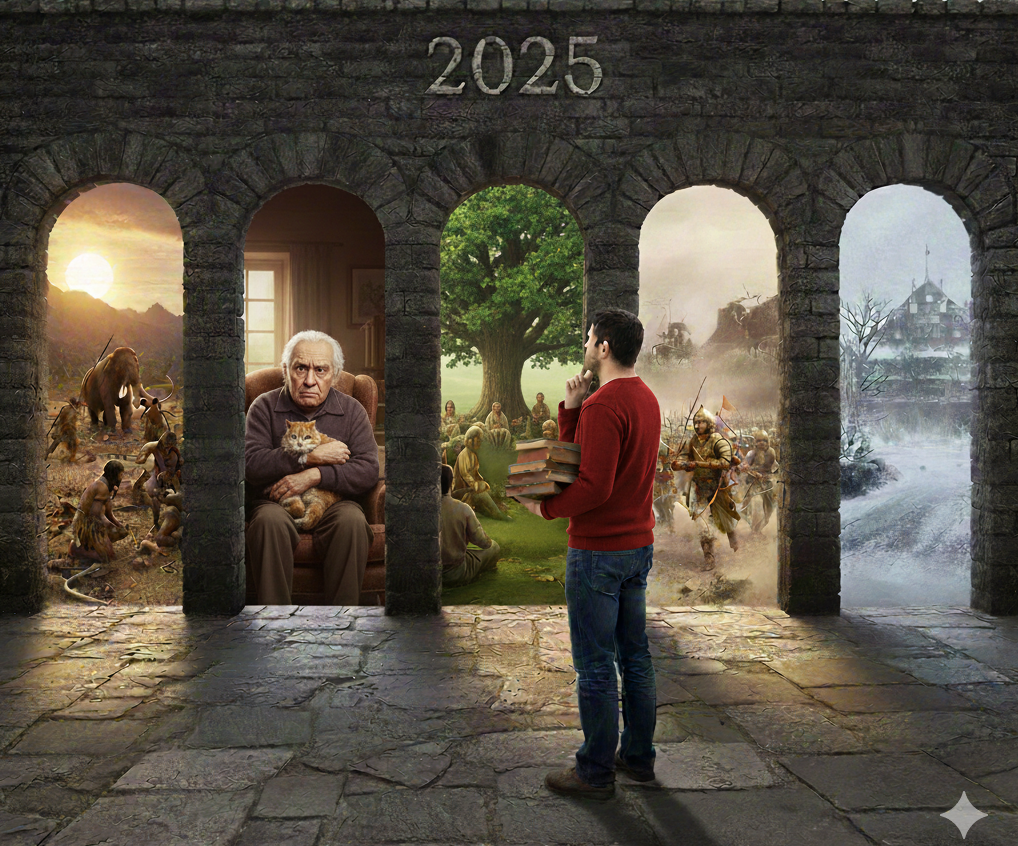
This year, I moved across worlds (quite literally) through my reading— some real, some imagined, some dark, and some wonderfully strange. Each book I read this year left behind something; a thought, a feeling, or a small shift in my perspective.
For me, reading stopped feeling like a routine or a race to finish one more book and instead became a way to explore new worlds, or to live new lives. It also pushed me to dig into genres I’d never explored before.
Here’s the journey I took, worlds I experienced, and my thoughts about each one of them, one book at a time.
Unstoppable Us (Parts 1 & 2) — Yuval Noah Harari
These books take us back to the time when humans were figuring out how to survive, socialize, and dream. Harari tells the tale of ‘rise of human civilization’, and answers few important questions like how our civilizations came into existence, why our world looks the way it does today, and how we came to rule the planet in ways no species ever has before.
My thoughts: These books made me feel like I was sitting around a campfire as a child, and listening to humanity’s entire history being told in the simplest and most fun way.
What I learned: Our strength lies in ability to imagine, cooperate, and build things much bigger than ourselves.
Tip: It could be an excellent choice as a gift for kids.
Purchase from here: Amazon (US), Amazon (India).
The People of the Indus — Nikhil Gulati
This book paints a vivid picture of one of the world’s oldest civilizations (Indus Valley Civilization) in simple words and beautiful visuals. It gently walks (quiet literally) us through their cities, people’s life, culture, and mysteries.
My thoughts: This book made me pause and look back at the roots of my land with pride. Getting to know our rich culture and history felt like rediscovering an old family story that no one told me properly.
What I learned: That ancient societies were far more advanced, organized, and harmonious than we often imagine.
Tip: Again, it could be an excellent choice as a gift for kids.
Our Moon Has Blood Clots — Rahul Pandita
A raw, heartbreaking memoir about the forced exodus of Kashmiri Pandits from their own land (Kashmir, India) in the early 1990s. Rahul also writes about the aftermath of the events, the trauma the families endured, and their hope for a better future.
My thoughts: The book, the story, the events — everything stayed with me for quite some time. Reading about real incidents — what people and their families went through, and how they survived, makes the book feel heavy and deeply affecting. Fyi, my wife is from Kashmir, so the narrative hit even closer to home and felt painfully personal. I feel it’s not just a book , it’s a voice that refuses to be forgotten.
What I learned: Life is so fragile. It reminded me to never take peace and safety for granted.
Feel-Good Productivity — Ali Abdaal
A light, practical book that explains productivity through joy instead of pressure. It teaches how feeling good can help you do good work. Ali shared research-backed strategies to help us feel good and get more done.
My thoughts: It gave me a fresh and realistic perspective on productivity. This book truly pushed me towards expressing my thoughts and gave me confidence to publish my articles.
What I learned: That doing what I genuinely love and what makes me feel good is the only way to do things.
The First Fifteen Lives of Harry August — Claire North
A timeless story about a man named Harry August, who lives his life over and over again. With each new life, he carries the memories of the ones before. I won’t say much more; anything else would be a spoiler.
My thoughts: A very unique and fresh science fiction. The plot slows down a bit in the middle, but once it picks up again, it becomes truly engaging.
What I learned: Even the smallest choices we make during our life can take us to a whole new direction.
Homo Deus — Yuval Noah Harari
Harari explores the humanity’s future as technology, data, and artificial intelligence begin to shape our goals and values. He challenges the happiness, free will and meaning of life in a data-driven world.
My thoughts: Detailed version of Unstoppable Us book series. Examples and stories to prove a point are great, but sometimes the points felt repetitive. It made me sit back and think about the future of humanity in a more serious way. Also, it urges you to rethink what it truly means to be human.
What I learned: The skills we have today may or may not be relevant tomorrow. Data and algorithms can make better decisions than us and it could change how much we rely on our own feelings and choices.
Storyworthy — Matthew Dicks
A fun, practical guide to telling better stories from everyday moments. It shows how small experiences can become meaningful narratives. He shared a lot of practical techniques to find, shape, and tell stories that truly connect with the audience.
My thoughts: Great book for anyone who wants to write or tell stories. I learned many practical techniques from it that I now use personally to craft my own stories. This book made me look at my own life differently. Also, gave me a push to pursue my interest to share things in the form of storytelling.
What I learned: To be honest, I learned many techniques. Above all, stories are everywhere, we just need to pay more attention to things we often ignore. Lastly, storytelling is a skill anyone can learn through attention and practice. (I can talk a lot about this book.)
1984 — George Orwell
A dark, unforgettable novel about surveillance, control, and the power of language. It depicts a totalitarian society where the Party monitors and controls every aspect of life, erasing truth and individuality. It is a story of Winston Smith, who struggles to maintain his personal freedom under constant surveillance.
My thoughts: The OG of dystopian fiction. The plot and premise is still relevant today. It feels like a warning. I would have appreciated it more if there had been a glimmer of hope in the ending, but it felt sad and depressing.
What I learned: That freedom can disappear quietly when we stop questioning the world around us. Big brother is always watching you.
A Man Called Ove — Fredrik Backman
A gentle, emotional story about a grumpy and lonely man whose is rule-bound and rigid. He is mean to everyone but through unexpected friendships and small acts of kindness, he slowly reconnects with his neighbors. This is also a story of love, loss and the quiet impact one life can have on others.
My thoughts: This is my first Fredrik Backman book. The writing is simple, the story is funny, yet unexpectedly heartwarming. It’s the story of the quintessential and old uncle in our society, someone you feel like you already know in your neighborhood.
What I learned: It reminded me how even the toughest people carry the heaviest stories. Kindness is never wasted and sometimes it saves people we don’t even realize are hurting.
Don’t Believe Everything You Think — Joseph Nguyen
A simple, short book that explains the difference between thoughts and thinking. It tells us how thoughts shape our emotions and how thinking pulls us away from our natural state of mind.
My thoughts: Very easy to read, with a simple yet powerful premise. I feel some ideas were slightly repetitive to make the point understandable. Overall, it felt like a friendly guide for a calmer mind.
What I learned: Thoughts comes naturally and are beyond our control, but it the thinking we engage in afterward and how long we choose to stay with those thoughts, makes the real difference.
Tip: A much needed for someone stuck in their thoughts. Could be a perfect gift to a friend.
Dance of Shadows — Gaurav Mohanty
A mysterious, thrilling, and magical tale set in the world of Mahabharata. Although it’s a successor to Son of Darkness, but the story runs parallel to the incidents that happened in the previous book. It has a character-driven plot which follows multiple POVs, each one have a role to play in the bigger picture.
My thoughts: I loved the vivid details and the imagery it painted in my mind. It truly felt like taking a break from reality and entering an entirely new world filled with politics, fantasy, magic, and dark characters. The story starts very slow but it becomes very gripping after midway through. However, I did not like the fate of some characters. I felt the story seemed to head one way, instead, it escalated in an entirely unexpected direction and some developments made no sense to me.
What I learned: At times, people do things that don’t make sense to us, but when we take time to understand their side of the story, those actions often begin to make sense.
The Shining — Stephen King
The plot follows Jack Torrance, who takes a winter caretaker job at the isolated Overlook Hotel with his family. The hotel’s dark presence gradually begins to affect Jack. His young son Danny, gifted with psychic abilities, can sense the change in his father and the growing danger.
My thoughts: This was my first book of ‘The Stephen King’ and my first time exploring the horror genre. It didn’t feel like traditional horror as I was expecting something else, maybe ghosts or jump scares. But the plot, characters, and atmosphere stayed with me for quite some time. I will say this book’s ending aged very well and I started appreciating the story even more a few days after finishing it. The second part ‘Doctor Sleep’ is already on my TBR for next year.
What I learned: Not all horrors need monsters or ghosts.
The Ayodhya Alliance — Ashwin Sanghi
The story is a quest of industrialist Aditya Pillai and South Korean technocrat Somi Kim to uncover a forgotten technology linked to India’s past. Along the way, they discover the hidden details about an ancient alliance that connects Ayodhya with Rome, Damascus, and Korea. It blends ancient secrets, myth, and modern science in a fast‑paced thriller.
My thoughts: I am a sucker for scavenger hunts, fast pace thrillers with mythological touch. This book had all the elements I usually enjoy. However, it felt like the sense of urgency and thrill was somewhat lacking. I really loved the extensive research Sanghi put into this book though.
What I learned: Attention to detail and the careful world-building can turn complex ideas into an engaging and believable narrative.
Red Rising — Pierce Brown (just started…)
Just started this one. Feels like entering a whole new dystopian world. I’ve read The Hunger Games and loved Katniss, but I’m not sure if Darrow and his story will reach that same level. Hoping for the best. 🤞🏼
Closing Thoughts
See, I told you I explored many worlds this year, and each one was unique in its own way. Looking back, I realize I didn’t read many books, but I have tried to keep my reading an activity I genuinely enjoy and feel relaxed while doing it, rather than racing to the last page. I took my sweet time to finish each book. One thing I focused on was maintaining my reading streak, even on a super busy day, I tried to read at least two pages. My current streak stands at 155 days.
I had a wonderful time with these books, and I hope you find something interesting to pick from my list. If you have any recommendations, I’d love for you to share them in the comments! Bye.


Comments