
Life is full of paradoxes. The harder we try to sleep, the more awake we feel (sleep paradox). The more options we have, the harder it is to decide (paradox of choice).
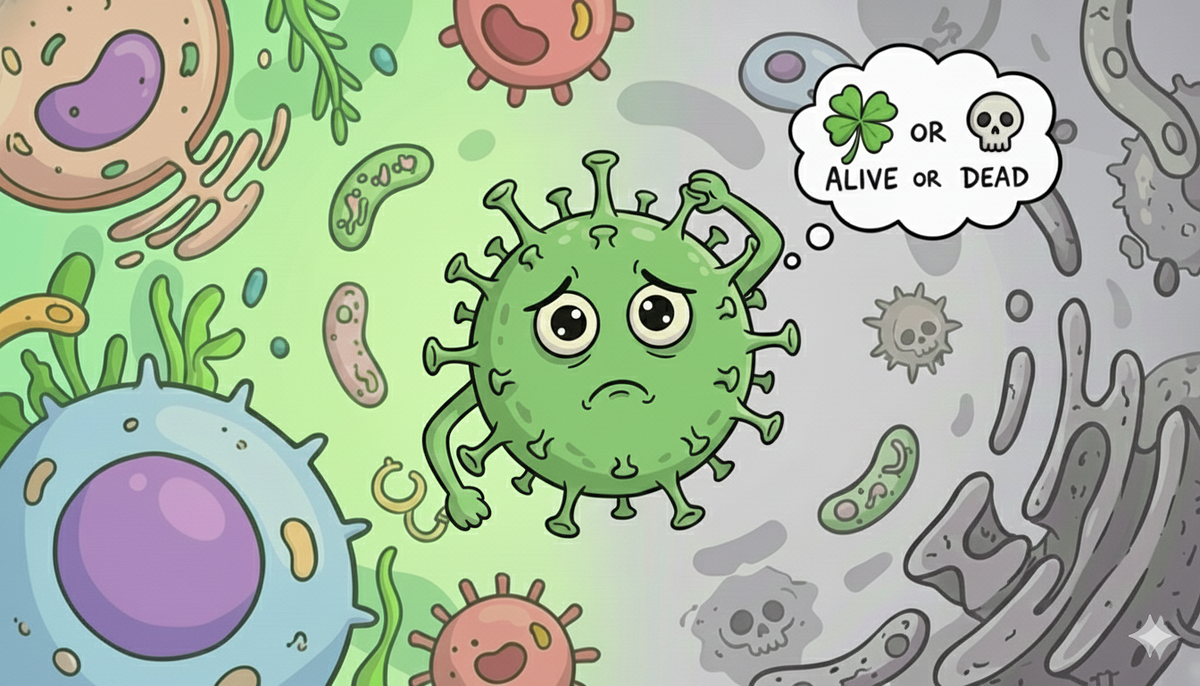
We encounter these little paradoxes every day without thinking much about them. But some are much deeper and go beyond our daily annoyances. Take viruses for example. They are neither truly dead nor truly alive, rather exist in a state between the two. Strange, isn’t it? This paradox of being living or dead is what makes viruses endlessly fascinating.
We have always thought of life in simple terms: something is either alive or dead. But viruses stand somewhere in the middle. Most importantly, they dance between these two states as it suits them. I know you might be wondering, how can anything be both dead and alive? If a virus is lifeless, then how does it come to life? And if it can come to life, was it ever truly dead in the first place?
To make sense of this odd in-between state, we first need to step back and ask a basic question: What makes something alive?
Our Science textbooks taught us that things which can grow, reproduce, use energy, and respond to their environment are considered ‘living beings’. Humans, animals, trees, or even bacteria clearly fit this definition. However, viruses break the rules. On their own or outside a living body, they don’t breathe, move, eat, or grow. Technically, they are not alive. But, when they enter into a cell, the story changes completely. Suddenly, they come to life (just like The Undertaker from WWE) as if they were never dead. They hijack the host, make copies of themselves, evolve, and while doing so, cause havoc.
Now, let’s tackle the next question: how do viruses “come to life”?
To understand that, we need to have a look at the design of viruses.
They are beautifully designed tiny bundle of genetic codes wrapped in protective coat of proteins. Yes, they are surprisingly elegant in their design. Just look at this image (Link to the image).
Inside, this genetic code has all the information they need: how to replicate, how to bypass cellular defenses, how to enslave cell and make more copies of themselves. The proteins on the outside serve a glorious purpose. With their exquisite design, these proteins decide which cell to latch onto and deliver the genetic code into it.
That’s all a virus really is: a script and a delivery system.
They remain completely inactive (dead), until the outer proteins find the right kind of cell. Once they do, it’s like hitting a jackpot. The genetic code is released inside the cell, and that is when the real show begins. The script unfolds slowly and our cells start dancing on virus’s instructions. And we all know, what happens when we follow someone else’s instructions. Total chaos. 💥
Now, what did we learn from this?
Viruses show us that the boundaries we draw between living and non-living are not always very clear. Just as life’s small paradoxes sometimes make us smile or shake our heads, the paradoxical nature of viruses makes us reconsider our notions about life. Now, if someone ask, What does it truly mean to be alive? Know that, this is not just a philosophical question, but also a scientific one. Choose your answer wisely. 😉


Comments